 Palimio
How to Grow Your Social Media in 2026
Everyone can see what their posts did. Almost nobody can see why. In 2026, that gap decides who grows.
June 7, 2026
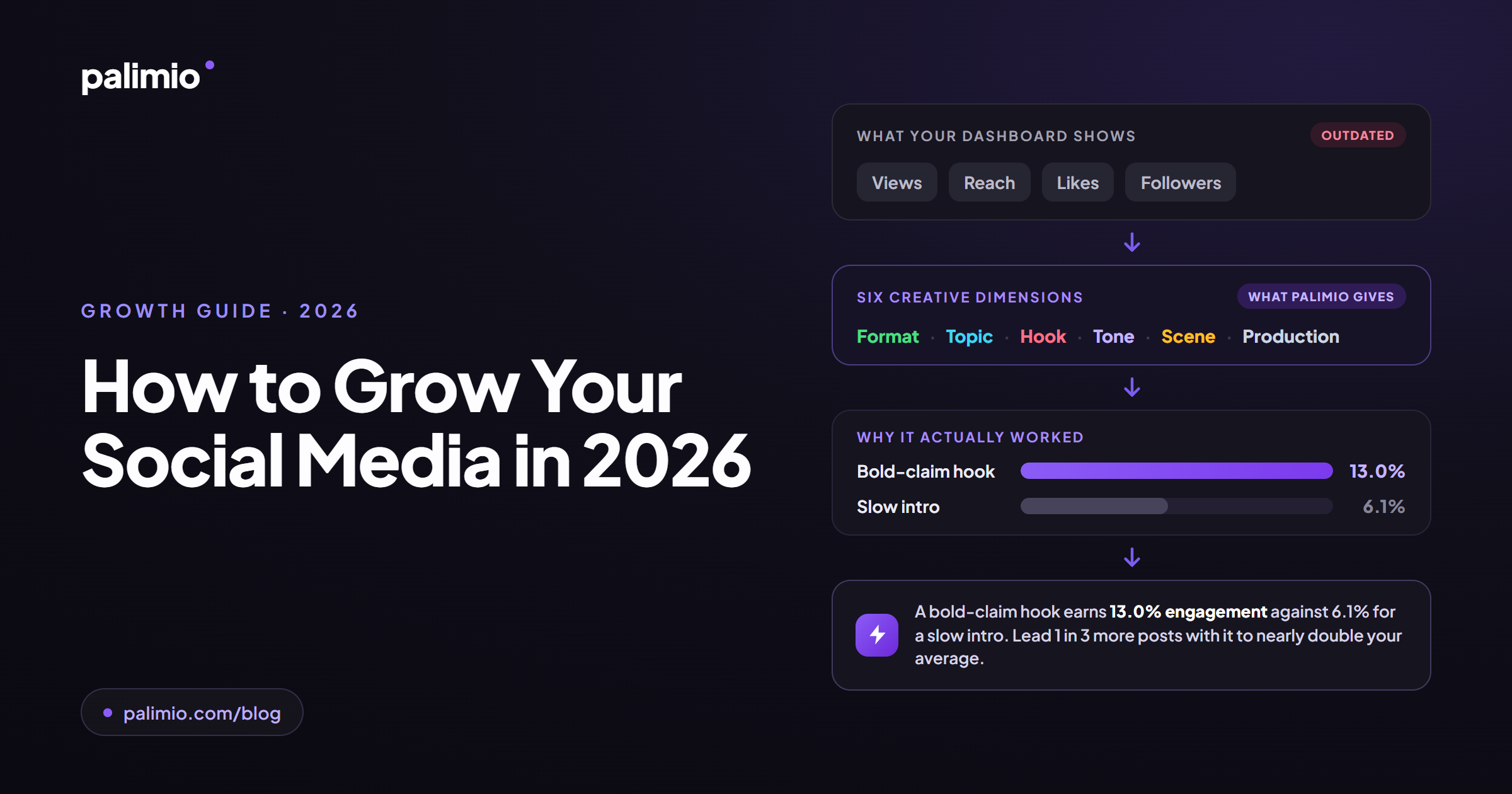
The way social media grows changed, and most teams are still running the 2019 playbook. Follower counts don't predict reach. Posting schedules and hashtags are no longer levers. On every major platform, a recommendation algorithm decides who sees each post, based on how the content performs in its first hours, not on who follows you.
That moves the whole job. Growth is no longer a distribution problem (post more, post at the perfect time, post what you think is "good content"). It is an understanding problem: knowing which creative choices make content perform, so you can do them again on purpose. The hard part of social in 2026 is not making or posting. It is knowing why one post worked and the next one didn't.
This guide covers what actually drives growth now, the advice worth dropping, the framework that works, and why the analytics most teams pay for cannot touch the only question that matters.
What actually drives social media growth in 2026
Three forces define the current feed:
The algorithm distributes your reach, not your followers. Each post is scored on early engagement (watch time, completion, saves, shares) and pushed to people who don't follow you if it performs. An account with 2,000 followers can outreach one with 2 million. Reach is earned per post, not banked in a follower count.
Short-form content is the discovery engine. Reels, TikToks and Shorts, and on Instagram, carousels, are how new audiences find you. The follower feed barely matters for growth now; the recommended feed is everything.
The signal that wins is "worth saving or sending", not "worth liking". The algorithm reads saves, shares and rewatches as proof a post earned real attention. Likes are vanity. Content that earns the deeper signals gets pushed; content that only collects likes stalls.
So you grow by repeatedly making content the algorithm rewards. Posting consistently still matters, but volume without understanding is just guessing at scale.
The growth advice that stopped working
Most of the advice still circulating was written for the 2018 to 2021 feed. Drop it:
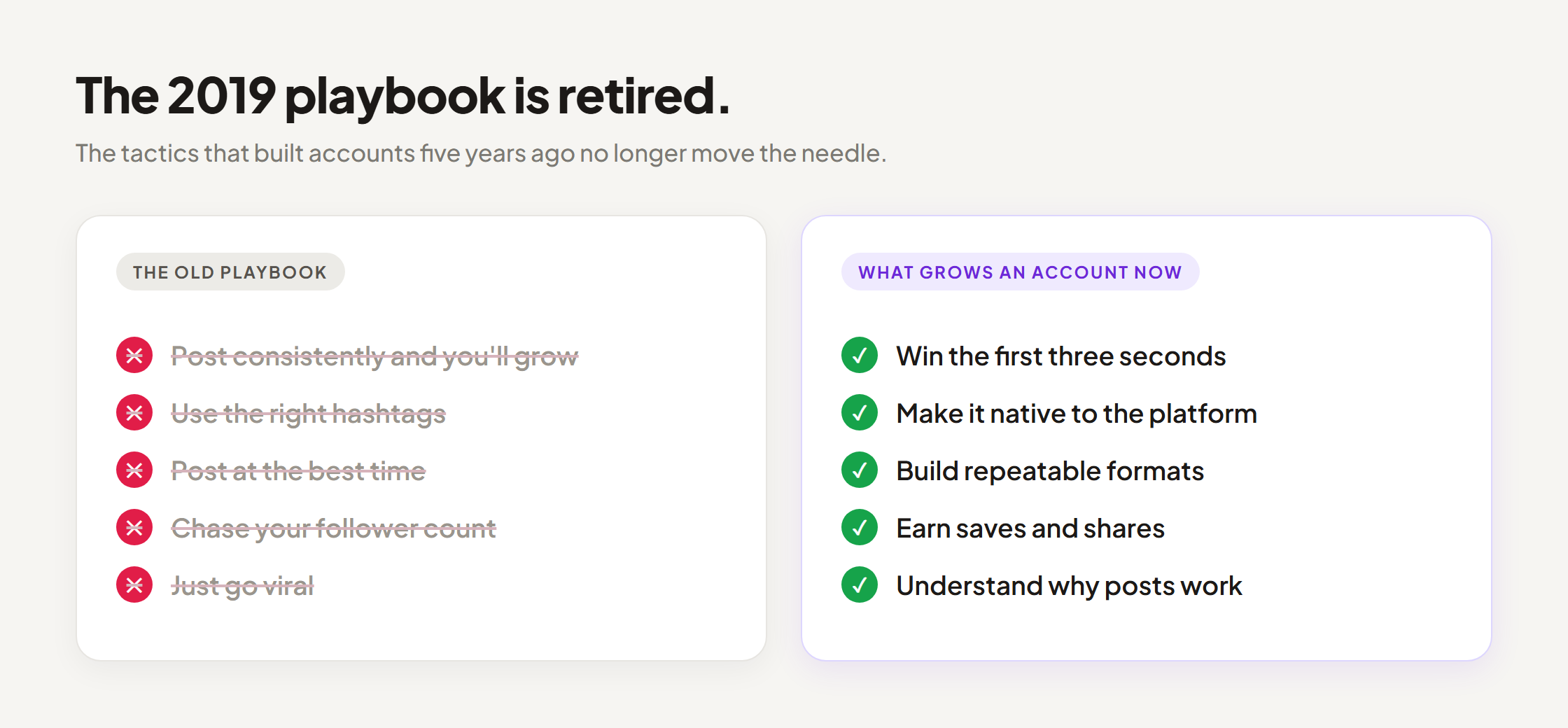
"Post consistently and you'll grow". Consistency compounds only if the content is good. Posting daily into the void teaches you nothing.
"Use the right hashtags". Hashtags no longer drive discovery. The platform reads the content itself to decide what it is about and who to show it to.
"Post at the optimal time". It no longer matters. A post can take off days later, so the content decides reach, not the clock.
"Grow your follower count". Followers are a lagging vanity number. Reach, saves and shares are what move.
"Just go viral". One hit you can't explain is luck. A repeatable format you understand is a strategy.
If your monthly report still leads with followers, post count and posting times, you are optimising a playbook the platforms retired.
What actually grows an account in 2026
Here is what works now, in order of impact:
Win the first three seconds. The hook decides whether anyone watches or keeps scrolling. Lead with the payoff, the tension or the visual. Most weak posts are good ideas with a slow opening.
Make it native to the platform. Reposted ads and recycled content read as foreign and get suppressed. Match the platform's pace, editing and tone.
Build formats, not one-offs. A format is a repeatable structure: a recurring series, a style of edit, a type of hook. Formats let you scale what works instead of starting from zero every post.
Make content people save and send. Ask of every idea: would someone send this to a friend, or save it for later? That is the content the algorithm rewards.
Find out why your best posts worked. The step almost everyone skips, and the one that compounds. When a post overperforms, pin down the exact creative choices behind it (the hook, the format, the topic, the tone) so you can repeat them deliberately.
Study your competitors' winners, then beat them. Your competitors run experiments in public every day. The patterns behind their best content are there to be read, if you analyse them instead of scrolling past.
Five of these six come down to one thing: understanding why content performs. That is exactly where almost every team hits a wall.
Why your analytics can't answer the growth question
Here is the uncomfortable part. The analytics most teams pay for cannot answer the question that drives growth.
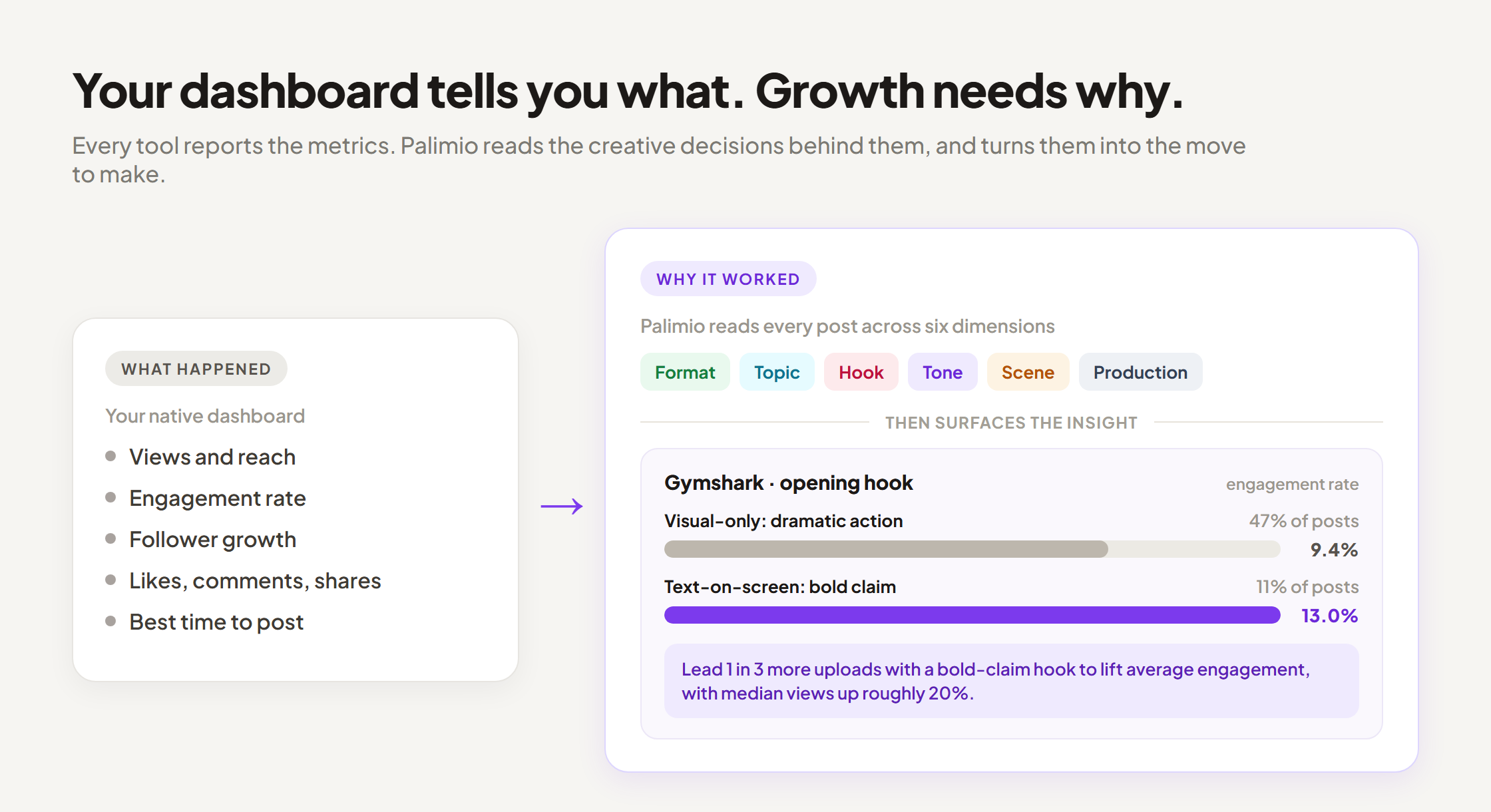
Your free native dashboards (Instagram Insights, TikTok Analytics) tell you what happened: views, reach, engagement rate, follower change. Useful, and already free on your phone.
The mainstream paid tools (Hootsuite, Sprout Social, Rival IQ and the rest) just repackage those same numbers into tidier reports and cross-platform rollups. They are scheduling and operations software with a dashboard attached. They track outcomes. Not one of them tells you why a post worked, or what to make next.
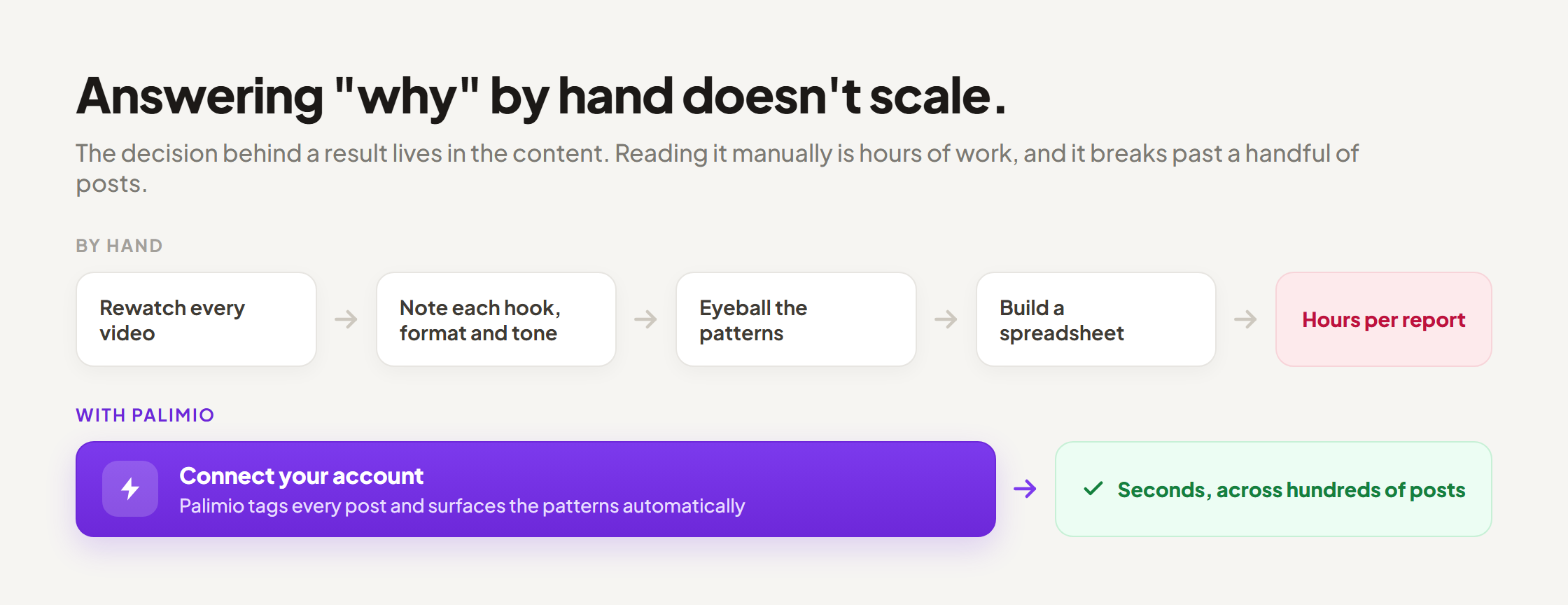
So the "why" lands on a person, and it is brutal, manual work. To understand why your top posts outperformed, a social media manager has to rewatch dozens of videos, eyeball the hooks, guess at patterns, build a spreadsheet and hold it all in their head. It takes hours, it is subjective, and it falls apart past a handful of posts. For a director trying to see patterns across a brand and its competitors, across hundreds of posts, it is not possible by hand at all.
That is the real bottleneck. The signal that matters most for growth, the creative decision behind a result, lives inside the content, and until now nothing could read it at scale.
The layer every tool has been missing
Every analytics tool in the category, free or paid, shares one unit of analysis: the metric. They count and compare numbers.
Growth is decided one level deeper, at the creative decision. Not "this post got 400,000 views", but "this post opened on a question hook, ran as a fast-cut talking head, covered a trending topic and kept a casual tone, and that combination is what travelled".
Working at that level means analysing the substance of the content, the things a person notices when they watch: the hook, the format, the topic, the tone, the scene, the production. No dashboard captures any of it. It is the missing layer in social analytics, and it is the layer that actually explains growth.
Palimio: the next generation of social analytics
Palimio was built to read that missing layer, and nothing else does it.
Instead of counting metrics, Palimio uses multimodal AI to watch every post: the video, the audio, the on-screen text and the caption. It tags each one across six creative dimensions: format, topic, hook, tone, scene and production.
With every post tagged this way, Palimio shows which creative choices are driving your reach and engagement, not just what the numbers were. It surfaces patterns no person could hold in their head, and it benchmarks you against competitors on the same terms, so you can see exactly what is working in your space that you are not doing.
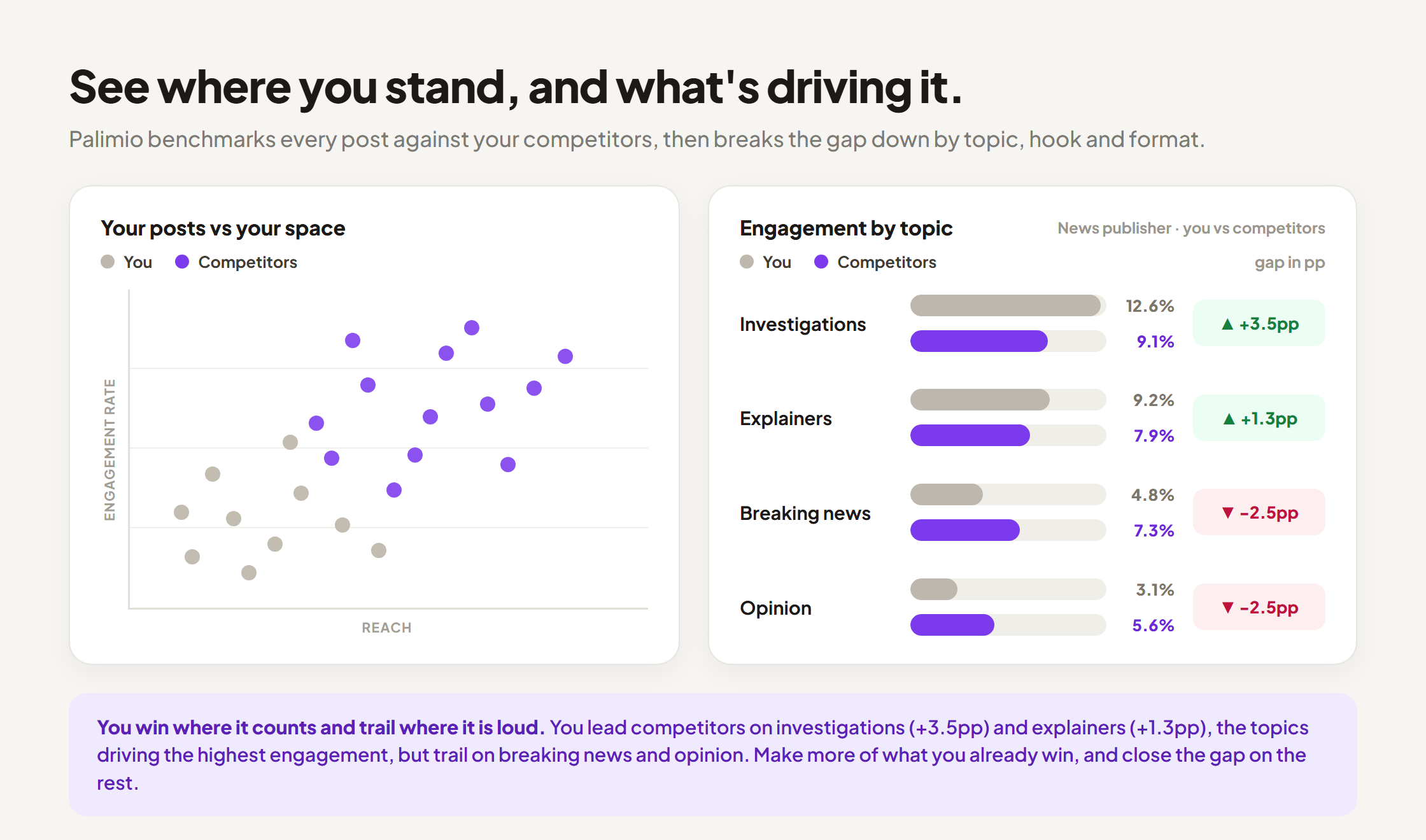
This is the part that was never possible before. Watching, understanding and tagging the creative content of hundreds of posts was a job no team could do by hand and no software could do at all. Palimio's own breakdowns show how often the answer hides in that layer: a major news publisher posting its weakest format the most, a global fitness brand whose most-used format is its lowest-engagement one, a brand whose reach collapsed while its engagement rate held. None of that shows up in a metrics dashboard, and all of it changes what you make next.
That is why this is a new category, not a tidier dashboard. The old tools answer "what happened". Palimio answers "why, and what to make next", which is the only question that grows an account.
What this changes for your role
This shifts the day-to-day for everyone who owns social:
Social media managers stop losing hours to rewatching content and building manual pattern spreadsheets. The "why did this work" analysis that used to eat a day is instant, so the time goes back into making content, and you walk into planning with evidence instead of gut feel.
Social media directors and heads of social finally see across the whole account and its competitors at the level of creative strategy, not a metrics rollup. You can see which formats and hooks carry performance, prove which creative bets paid off, and steer the team with patterns instead of opinions.
Social insights and analytics leads get a unit of analysis that never existed in the stack. Instead of re-reporting engagement rates the native apps already show, you can explain the creative drivers behind them and turn a backward-looking report into a recommendation for what to make.
In every case the move is the same: from guessing and manual review to knowing why your content works and what to make next. That is the difference between defending vanity metrics in a monthly deck and actually growing.
Your 2026 growth checklist
Treat every post as a bid for reach, not a slot to fill.
Win the first three seconds, every time.
Build repeatable formats, not one-offs.
Make content worth saving and sending, not just liking.
Stop reporting what happened and start understanding why.
Analyse the creative decisions behind your best posts, and your competitors' best posts.
Repeat what works on purpose, and cut what doesn't.
The teams that grow in 2026 are not the ones posting the most. They are the ones who understand their content the best.